




























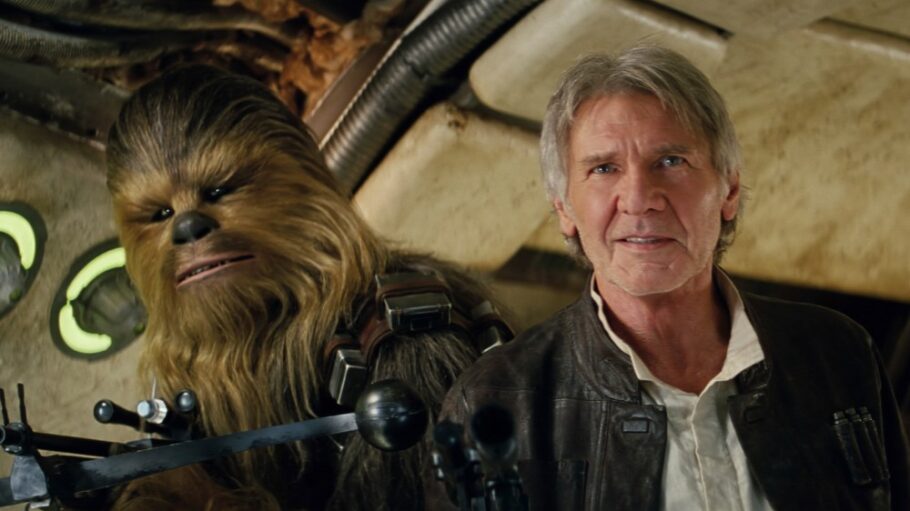
Ten years ago this week, “Star Wars: Episode VII – The Force Awakens” released in theaters, marking Walt Disney Studios’ first big-screen, live-action foray into the galaxy far, far away since it acquired Lucasfilm in 2012.
Though “The Force Awakens” opened to undeniably high anticipation, “Star Wars” fans circa 2015 approached the film with degrees of caution. Even though Disney had hired blockbuster producer Kathleen Kennedy to helm Lucasfilm, which had previously proven its ability to elevate a beloved franchise with their acquisition of Marvel in 2009, “Star Wars” fans knew what it felt like to have their grandiose expectations shattered after a decade-plus of build-up.
The last time that “Star Wars” came out of a long hiatus to expand the series was in 1999, when George Lucas returned to kick off the prequel trilogy with “Episode I – The Phantom Menace.” Despite stratospheric excitement built up over the 16 years since “Episode VI – Return of the Jedi” concluded the original trilogy in 1983, “The Phantom Menace” was far from universally beloved upon release, with many fans expressing deep ire for the creative decisions Lucas took with the story.
Therefore, when fans were promised more “Star Wars” in the form of a sequel trilogy beginning with “The Force Awakens,” they proceeded trepidatiously.
As details about the film started to fall into place, however, excitement became more difficult to restrain. It was announced early on that Harrison Ford, Carrie Fisher and Mark Hamill would be returning in the film, reprising their respective roles as Han Solo, Princess Leia and Luke Skywalker from the original trilogy. Meanwhile, behind the camera, “Empire Strikes Back” and “Return of the Jedi” scribe Lawrence Kasdan was working on the screenplay.
The major new addition to the franchise was director J.J. Abrams. After he sold the franchise to Disney, Lucas had become decreasingly involved in the sequel trilogy. Given his perceived misdirection on the prequels, however, fans showed little objection to the directorial reins being handed off. After all, neither “Empire Strikes Back” nor “Return of the Jedi” were directed by Lucas.
Abrams appeared a suitable successor. Coming up at the turn of the millennium as a writer and producer on movies like “Regarding Henry,” “Forever Young,” “Armageddon,” and “Cloverfield,” he made an exceptional directorial debut in 2006 with “Mission Impossible III.” Three years later, he demonstrated his ability to revive a beloved sci-fi franchise with the 2009 “Star Trek” movie, which accomplished the cosmic feat of appeasing Trekkies and general audiences alike.
Love Film & TV?
Get your daily dose of everything happening in music, film and TV in Australia and abroad.

Following a long, secretive production around the world, an 88-second teaser trailer for “The Force Awakens” released on Nov. 28, 2014, showcasing the first glimpses into the saga’s next chapter. While narrative details were sparse, the footage was beautiful. Crisp cinematography and spectacular set pieces evoked the magic of the original “Star Wars” movies paired with modern visual effects. The trailer also featured first looks at John Boyega’s Finn, Daisy Ridley’s Rey, Oscar Isaacs’ Poe Dameron, Adam Driver’s Kylo Ren and the voice of Andy Serkis’ Supreme Leader Snoke. There were also X-Wings, Stormtroopers, a new Light Saber and the Millennium Falcon. It was in with the old and out with the new, just as prequel-weary fans had hoped.
A subsequent trailer debuted at the annual Star Wars Celebration in Anaheim in April, 2015, showcasing shots of new characters and the first looks at Han Solo and Chewbacca’s returns. At the 2015 San Diego Comic-Con in July, Kennedy, Abrams, Kasdan and the cast all took the stage for the first time together. They showcased some of the film’s practical effects creatures, revealed behind the scenes footage and fielded questions from fans. They ended the night with a surprise “Star Wars” concert from the San Diego Symphony Orchestra, featuring music from John Williams — another franchise staple returning to score “The Force Awakens.”
A final trailer released alongside an official poster for the film in October. Despite the influx of materials, details about the plot and certain characters’ identities remained shrouded in mystery. Notably, people questioned why Luke Skywalker was absent in the poster and all of the trailers. These mysteries, however, invited theories, questions and debate, all of which created unprecedented buzz and discourse, even for a “Star Wars” film.
“The Force Awakens,” after all, was the first “Star Wars” movie to come out in the social media era. The original trilogy began in 1977, when film marketing was made up of billboards, newspaper ads and trailers that could only be seen in the cinema or on TV. The prequels then emerged alongside the early internet, but people still lined up to see “Meet Joe Black” when it was announced that the “Phantom Menace” trailer would play exclusively in front of the 1998 film. Fans could read updates and takes on the film via emergent websites like IMDb and Ain’t It Cool News, and contribute in private chatrooms, but the behemoth of social media was still yet to arrive. The prequel’s final chapter, 2005’s “Episode III – Revenge of the Sith,” released just months after the advent of Facebook and YouTube.
READ MORE: ‘Star Wars: The Force Awakens’ Director J.J. Abrams Knows He’s Driving Us Crazy with Teasers
Like anything to gain traction on social media, though, not all discourse surrounding “The Force Awakens” was positive. Some viewers flied their fandom flags with toxicity. Most egregiously, a faction of fans voiced complaints about the trailer’s opening shot of John Boyega in Stormtrooper garb, claiming that a Black man could not portray a Stormtrooper based on the canonically-debunked grounds that all stormtroopers are clones of Jango Fett (Temuera Morrison). This led to posts and memes that claimed “Star Wars” was promoting White genocide and that fans should boycott the new film.
Concerns were also raised when audiences noticed that the Chinese poster for the film had shrunk John Boyega’s image. Questions emerged as to whether Disney intentionally minimized the Black actor’s likeness to appeal to Chinese audiences that may not be as welcoming to a diverse cast. Oscar Isaac and Lupita Nyong’o’s characters were also omitted from the Chinese poster, despite being present in other territories’ prints.
Meanwhile, fans raised questions about less political matters with similar fervor. Why did Kylo Ren’s lightsaber have a crossblade? Why was Darth Vader’s helmet in the trailer when it was supposed to be cremated with Anakin’s body in “Return of the Jedi”? Why are there still Stormtroopers, TIE Fighters and X-Wings if the Rebellion defeated the Empire at the end of the original trilogy? For better or worse, many had strong opinions on “The Force Awakens” before it came out.
Few of these opinions, however, seemed to hinder people from actually showing up to see “The Force Awakens” in December. On Dec. 14, the movie took over Hollywood Boulevard, concurrently premiering at the TCL Chinese Theatre, the El Capitan Theatre and Dolby Theatre to a collective audience of over 5,000.

©Walt Disney Co./courtesy Everett / Everett Collection
The movie earned a record-breaking $50 million in pre-sales and went on to have the highest-grossing opening weekend ever at the time, making $247 million at the domestic box office. It played across 3D, RealD 3D, IMAX 3D and 4DX formats on over 4,000 screens in the U.S. and Canada alone.
In total, “The Force Awakens” grossed $2.07 billion at the worldwide box office, becoming the third-highest grossing film of all time behind “Titanic” and “Avatar.” Today, it still holds the No. 6 spot, and though its box office falls behind the original “Star Wars” when adjusted for inflation, the 1977 movie came out before home video and therefore enjoyed a multiple-year-long theatrical run whereas “The Force Awakens” arrived on DVD the following April.
Not only was “The Force Awakens” a box office success, but initial reactions to it were largely positive. Fans and critics alike appreciated the mix of humor and action that felt reminiscent of the original trilogy. The prequel’s cumbersome politics and glossy digital effects were subdued in favor of a traditional hero’s journey and a more tangible aesthetic. Audiences around the world cheered when the opening crawl appeared on screens and the excitement remained through the credits.
Admittedly, not everyone was pleased, though. While most relished the movie’s warm nostalgia, some criticized it for lacking originality and following a storyline that too closely mimicked the arc of “A New Hope.” Even George Lucas himself expressed disappointment in the movie’s “retro” approach to the franchise that he always sought to expand.
With two more films to round out the sequel trilogy on the horizon, and standalone “Star Wars” anthology films promised between and beyond the Skywalker Saga installments, Disney had opportunities to appease the wide fan base. It seemed to be on the right track when it released the first anthology movie a year later: the Gareth Edwards-directed “Rogue One: A Star Wars Story.” The movie, which diegetically took place between Episodes III and IV, was praised as an original story with just enough narrative and aesthetic tie-ins to keep things familiar.
The franchise’s footing started to shake a bit with its subsequent film, though. Seemingly swinging the pendulum in the opposite direction of “The Force Awakens,” the Rian Johnson-directed “Episode VIII – The Last Jedi” opted for an extreme departure from all “Star Wars” movies that came before it. It introduced new concepts, offered a less conventional narrative and provided space for Johnson to bring his more indie sensibilities to the blockbuster franchise.
These decisions estranged those who appreciated the nostalgia of “The Force Awakens” nostalgia, but didn’t do much to placate its critics either. Though Johnson showcased some interesting aesthetic choices, the decisions to make Luke Skywalker a reluctant hero, to have Finn and Rose (Kelly Marie Tran) embark on an inconsequential side quest and for Poe’s main arc to end with an obedience-affirming lesson simply felt unbecoming of a series built on hope and rebellion. While originality may have been craved, subversion was not so well received. “The Last Jedi’s” box-office dropped to $1.3 billion while discourse surrounding the franchise grew hotter and heavier.
The franchise hit a box office low with its next release, “Solo: A Star Wars Story.” The franchise’s second attempt at an anthology series only grossed $393.2 million. Meanwhile, its decision to recast young Han Solo as Alden Ehrenreich when fans so strongly associated the character with Harrison Ford sparked even more hostility. By the time the Skywalker Saga came to a conclusion with “Episode IX – The Rise of Skywalker” in 2019, many fans were either checked-out or jaded.
Despite an early “Episode XI” story in development from director Colin Trevorrow, Lucasfilm ultimately decided to hand the baton back to Abrams to conclude the sequel trilogy. The final installment retconned many of the digressions that Johnson made in “The Last Jedi,” but rather than course correct and conclude the arcs set up in “The Force Awakens,” it opted for a path of least resistance, inexplicably bringing back Ian McDermott’s Emperor Palpatine as the archvillain and revealing Rey to be his granddaughter. The best explanation for this wasn’t even featured in the film, but revealed in a Fortnite tie-in event ahead of the release. The film grossed $1.07 billion, a billion shy of what “The Force Awakens” grossed four years prior.
There have been no “Star Wars” movies since “The Rise of Skywalker.” Plans for Boba Fett and Obi-Wan Kenobi films were turned into television projects, as the franchise has largely become a TV property since the launch of Disney+ just a month before “The Rise of Skywalker” released. While some of the shows like “The Mandalorian” and “Andor” have accrued respect from fans and critics, others like the aforementioned Boba Fett and Obi Wan series, as well as “Ashoka,” “The Acolyte” and “Skeleton Crew” have received mixed reviews and failed to gain much cultural traction. Arguably the most consistent television “Star Wars” has produced has been in the realm of animation, with “Clone Wars” spinoffs aplenty maintaining the spirit of the original show.
Meanwhile, promises of additional films have come and gone over the years. Disney announced that Rian Johnson and Simon Kinberg would each get their own trilogies, but no updates have been given on either in years. Daisy Ridley’s Rey was rumored to have more movies focused on her, but little has been said about them either. Furthermore, “Game of Thrones” creators David Benioff and D.B. Weiss and even Marvel executive Kevin Feige were in talks to helm movies, but they’ve all become the ephemeral stuff of legends. Recently, it was revealed that Adam Driver and Steven Soderbergh also pitched a continuation of Kylo Ren’s story, which Disney rejected on the basis of the character’s death in “The Rise of Skywalker”— an ironic justification for a series that has a habit of bringing back its dead antagonists.
The Force may have awoke in 2015, but for the past 10 years, Disney has seemingly been pressing snooze on “Star Wars.”
Next May, however, the alarm will go off again, as “Star Wars” finally returns to the big screen for the first time in seven years with the theatrical release of “The Mandalorian and Grogu.” Directed by Jon Favreau, who created the Disney+ series “The Mandalorian,” the feature holds promise, but its ties to the show demonstrate how far the franchise has leaned towards television in the past decade.

Nicola Goode
A presumably original story will arrive in 2027 with “Star Wars: Starfighter” directed by Shawn Levy and starring Ryan Gosling releasing in theaters. Little has been revealed about the story, which is being penned by “The Adam Project” scribe Jonathan Tropper.
For both of these films, fans likely be going to the theater with caution once more. Unlike when “The Force Awakens” came out though, fans have not been starved of “Star Wars” content for the past decade. Rather, there has been a wealth of “Star Wars,” but of varying quality and conspicuously little of it on the big screen.
Ironically, “The Force Awakens” faced both praise and criticism for its embracement of nostalgia upon release, but today, it can almost be watched as a nostalgic piece of cinema itself. Consider that the kids who saw the film in theaters in elementary school could now be in college. In the same way that the prequels have garnered newfound love from the kids who grew up with them in the ’90s and 2000s in recent years, “The Force Awakens” may have now passed the threshold of nostalgia — nostalgia for a time when a legacy sequel could still evoke something special, when event-cinema still brought people out to the theater, when the line between a theatrical and streaming release was not as nebulous, and when franchises could deliver fan service with quality rather than quantity.
It seems dubious that Hollywood might be able to recapture that magic today, but as Han Solo would say, “Never tell me the odds.”
From Variety US