





























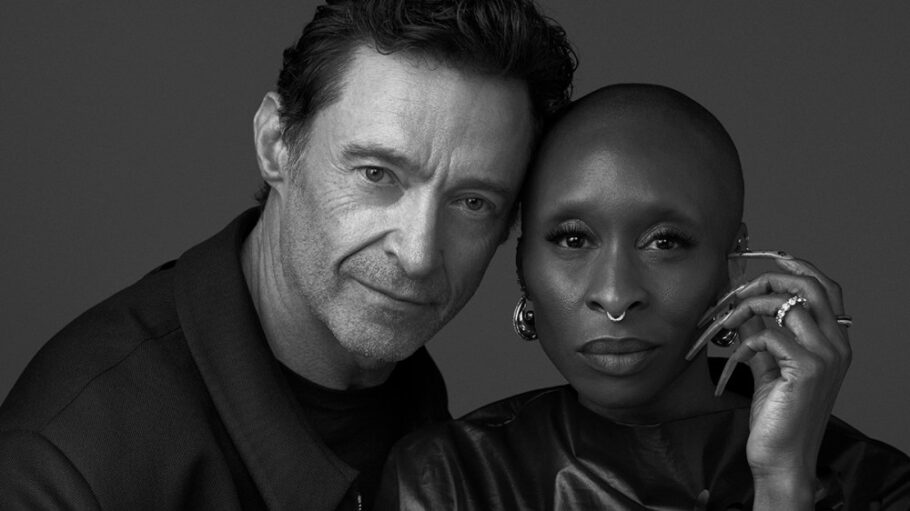
“Please be great. Please be great.”
That’s what Hugh Jackman, a veteran of both the screen and the stage, nervously whispers to himself every time he sits down to watch a new movie musical. But he’s finally comfortable declaring that his favorite genre is “back” after starring in “Song Sung Blue,” a biopic about a Midwestern married couple-slash-Neil Diamond cover band — and especially after seeing the long-awaited two-part film adaptation of a certain iconic Broadway musical.
Cynthia Erivo, 38, has had a steady career in theater and film for years, but her performance as Elphaba in “Wicked” and “Wicked: For Good” has catapulted her to a level of visibility that’s uncommon for musical theater actors. Of course, Jackman, 57 — who’s had turns in “Les Misérables,” “The Music Man” and “Oklahoma!” in addition to the 10 films in which he’s played Marvel’s Wolverine — is one of the few who can relate. As the two friends sit down to discuss their current films, they return again and again to the idea of their work as an act of service. It’s the only way, they say, to stay grounded in Hollywood.
Hugh Jackman: Are you exhausted?
Cynthia Erivo: Today I feel quite floaty, not exhausted. I’ve been doing things to make sure I’m still able to function in the right way.
Jackman: I just went backstage at Jonathan Groff’s show. I said, “How are you doing?” He goes, “Great.” I said, “How?” And he said, “I just made this decision that I was going to finish stronger than when I started. I’m doing anything I have to do to make sure I finish stronger.”
Erivo: When I get to a venue, I ask before we begin to make sure there’s a treadmill in the room so I can get up in the morning — there’s no excuse — and run. I take every kind of tea that I need with me, all the protein bars, my vitamins: I always have them. Those things help me stay well and strong, and also stay bright and happy.
Love Film & TV?
Get your daily dose of everything happening in music, film and TV in Australia and abroad.

Jackman: We totally could have done this on the treadmill. I would have been up for that. I’ve been in some big, anticipated movies, and I know what that’s like. How long was the shoot?
Erivo: Rehearsal started in August. We started shooting in December of 2022 —
Jackman: Whoa, whoa, whoa. Four months of rehearsal? That’s heaven. We had nine weeks for “Les Mis” and I thought that was a lot. You guys had 16.
Erivo: We really had time to dig in and find out what the arc was. We started shooting, we had that massive break because of the strikes, and then we came back in 2024.
Jackman: That’s right. I remember being at a hotel, coming back for “Deadpool & Wolverine” and Jonathan Bailey was there training. What a voice. And a fantastic actor.
Erivo: I love working with him. It was interesting because Fiyero and Elphaba, onstage, you don’t have much time to find out how they get where they are. But with this, we had time to breathe into it a little bit more. You get to see a side of her that you don’t necessarily even know is there — this beautiful, softer side.
Jackman: I want the world to have movie musicals, and thankfully, they’re back. Any expectation I had, you just sailed [past]. It’s the Mount Everest of movie-making, musicals. I really think it’s the hardest thing to pull off.
Erivo: This is all testament to Jon Chu. It’s very hard to pull off, because you have to convince people that it makes sense for each of these characters to burst into song. And it’s the moment between the speaking and the singing. It’s the silence. And every time, he would find a way for us to find that invisible thread so that there is no other choice but for these characters to start to sing.
Jackman: I always think of Travolta in “Grease.” When he gets dumped by Olivia Newton-John, and he’s stranded at the drive-in, watch his commitment to it. There’s not one part of him that feels awkward breaking into song. You guys all have that. When I worked with Trevor Nunn when we did “Oklahoma,” he wouldn’t let us sing for the first three weeks. He was like, “No. You need to make the lyrics work as if they’re thought. It’s no different to Shakespeare. That’s not the way you speak, but you have to make it feel like that’s the way you speak.” Curly has the first song, and every verse, he repeats the first line. I say, “All right, Trevor, come on. ‘There’s a bright golden haze on the meadow. There’s a bright golden haze on the meadow.’” He goes, “You better find a reason to say it.”
Erivo: I was today years old when I found out that your first time on Broadway was the same time that “Wicked” started. When was that?

Jackman: 2003. You were a baby. I was in “The Boy From Oz,” and “Wicked” was a smash. We were all at the Tonys together. “Wicked” didn’t win. But when they announced it — do you know this?
Erivo: I don’t. Give me this trivia.
Jackman: They said, “The winner of the Tony for best musical is” — and they put up “Wicked” on the screen — “‘Avenue Q!’”
Erivo: Are you joking?
Jackman: I hope I’m OK to say this — [“Wicked” producer] Marc Platt [was also] the producer of “La La Land.” Cut to when they give him the Oscar [in 2017], and when they’re on the stage, they take it away from him. I think he’s like, “Literally, is everything going to be taken from me?” Anyway, I think that’s kind of a cool thing.
Erivo: I watched “Song Sung Blue.” My heart was broken. What was really beautiful was to see you return to music. I wonder how it felt.
Jackman: There was something about playing Mike Sardina. He’s a tunnel rat. Came back from Vietnam addicted. You find him 20 years sober, but life is a battle, and what’s holding it is this dream. Somehow, I’ve been able to live my dream from the jump. But I always open myself up. I ask this in my dreams: “Let Mike teach me. We’ve come together for some reason, and we’re going to learn something from each other.” And what Mike allowed me to do is to just entertain. To not be fussy about how I sounded. He didn’t even care if he sounded particularly like Neil Diamond. He just wanted to entertain people. That is in my DNA, but it’s something I forget sometimes. Sometimes I get a bit shy or perfectionist. Mike had 20 or 30 heart attacks. He had no idea how long he was going to live. He’s doing oil changes to make ends meet, and he’s got this dream of just being able to sing. Almost everyone was saying to him, “Give it up. Come on, man. You’re dreaming too big. This is naive.” And he just refused to say no. This was a great reminder to me: Trust your gut, and refuse to say no.
Erivo: The special thing about your movie is the everydayness of it. The people who live and work from one day to another and just have a simple dream of being in front of people and being able to sing. It connects us to the humanity that we sometimes forget about.
Jackman: Can I ask you another question? Stephen Schwartz. The new songs. How cool is that?
Erivo: The first time we heard them was at Jon Chu’s house. Stephen Schwartz gets on the piano. He starts playing, and said, “This is your song, and this is your song.” [Ariana Grande and I] were really overwhelmed. That was also the first time we had sung together. We sang “For Good.” We didn’t audition together. It was such a wonderful moment of knowing that this was the right partner. We had chills. There were tears. The whole lot.
Jackman: Your voices blend so beautifully together.
Erivo: We had no idea they would.
Jackman: Did you suspect that?
Erivo: No, because our voices are so different. It’s a lovely thing. When we would record tracks for rehearsal purposes, you could see the vocal lines on the screen, and our vocal lines were the same, which never happens. You can’t orchestrate that. It’s such an odd thing to know that this person who I had never sung with before, who I’ve met for the first time because of this, we matched. We were right for each other.
Jackman: And then you got up at the Oscars and sang “Defying Gravity.” Owned it. I’ve hosted the Oscars, so I know that moment.
Erivo: I was really, really nervous. I always have nerves before I go onstage. Before I come onstage, I ask for whatever I’m doing to connect with whoever it needs to connect with, so that it’s not just for me. And because it’s not just for me, then I can send the energy outward, and I can then actually see people. There’s something about being able to see people’s eyes.
Jackman: Anyone who’s studying acting, listen to this. This is the key.
Erivo: At some point you’ll find a set of eyes that just settles everything. And then I can keep going.
Jackman: I take a minute before I go out, and I say a little phrase: “Allow this moment to be in service. Of consciousness. Of God. Of the absolute. Of whatever it is” — beyond Hugh Jackman or the Oscars or what this is going to do for me. I need that.

Erivo: It makes the reason for what you’re doing so much bigger than just performing and having a great moment. It makes it about someone who’s far, far away, who just needs to see this. Someone who’s in pain. Someone who needs release. Someone who needs joy. Maybe this will help in some way. I have to believe that’s what this is all really for.
Jackman: The movie comes out next week. Obviously, it’s with you for the rest of your life — you may not know that yet, but I can tell you, eight years after “Greatest Showman,” you will have more and more gratitude for it, and it will mean different things to you as it goes on. Do you have any rituals at the end of a movie?
Erivo: Sleep. And then a therapy session. Through the process, I’m often holding onto emotions, and once the thing is released, I really allow myself to let it all go. Last time, the end of the road was the Oscars. I was on a plane to South Africa to start a new movie, and I just cried the whole way and let myself be.
Jackman: It’s been a pretty massive four or five years. Is it settling in? I went through a bit of it with “X-Men.”
Erivo: Tell me about that.
Jackman: I was 29. Luckily, no one recognized me as Wolverine on the street. I remember two guys arguing — in front of me — “That’s him!” “That’s not him.” I pulled out my license to settle the argument. It took me a few years just to feel grounded.
Erivo: If I had been 29 when this was happening, I think I would be a little out of control. But because I’m 10 years older than when you first started, I think I’ve found the ground. I have really good people around me who are helping to make sure that I’m still connecting with the floor.
Were you a fan of Neil Diamond before you began [“Song Sung Blue”]?
Jackman: When I grew up, “Hot August Night” was the album everyone played. I was definitely a fan. And luckily for me, Mike would say, “I’m not sounding like Neil. I don’t look like him. I’m an interpreter.” But I would try to listen to the way he phrased things. We have the same range. And Kate Hudson, she’s as much a singer as she is an actor. She told me a story of her mum, Goldie Hawn, making her sing at a party that Quincy Jones was at. She was 15. As Quincy was leaving, he rolls down the window of the car and goes, “You need to be recording. I’m telling you. Record.”
Erivo: You have such a beautiful chemistry. It’s like the two of you have known each other forever. How do you let go of those characters? Because I’m a geek, I went back to “The Prestige” and “Prisoners,” and they’re such full, deep, grit-filled roles.
Jackman: It’s changed over the years. If I go back to “Prestige” or “Prisoners,” I didn’t know how to finish something. I thought, “Well, you’re an actor. You play it, and then you move on.” But I can look back now and see that that’s not enough. With this experience, I trusted more. In the past, I’ve been a little more controlled or more planned. I was like, “Just trust.” And I can see it on screen, and I go, “Good on you.”
Erivo: Is that a recent thing? Do you know why it’s taken this time to get to the place where you can just let go?
Jackman: I think it’s connected to worrying what other people think.
Erivo: You? You still worry?
Jackman: A lot less. I think that was the turning point. Like, “You’ve done OK. Trust your instinct. You know what you’re doing.”
Erivo: You do.
Jackman: It can be easier than you think. It doesn’t always have to be torturous. You can just be. And I’ve learned it’s as important to mark the ending of something as it is the beginning.
Erivo: Is it the end for you when it comes to Wolverine?
Jackman: It doesn’t feel like the end. It really felt like the end after “Logan.” Actually, I needed to claim it as the end, because I really believed in some things that I wanted that movie to be, and I had to fight for them. I had to say, “This is the last time I’m doing it.” Then when I saw “Deadpool,” I was like, “Oh. I see ‘48 Hrs.’ I see Eddie Murphy and Nick Nolte.” But I would shove it down. “I’ve told everyone that I’m done. I’m not one of those guys.” Then I went, “You know what? I change my mind. It’s not that big of a deal. I’m not even gonna say I’m sorry.” And it was so awesome. What’s next for you?
Erivo: I have a book coming out. It’s a collection of stories from my life that have taught me some lessons, and it asks a couple questions of the reader that helped me process a few things.
Jackman: There’s a theme here. Your purpose of getting up there is to open the hearts of the people who you’re performing for. There’s a humility in it. There’s a power in it. It’s loving. And it’s someone who is comfortable in themselves.
Erivo: Yeah. Because I know what I have. So I’m OK with sharing it.
Production: Emily Ullrich; Agency: Nevermind Agency
From Variety US